









Barbara Bako, Bangkok.
The International Monetary Fund (IMF) has warned that global public debt is projected to reach 100 per cent of Gross Domestic Product (GDP) by 2029, urging governments to urgently strengthen public finances as rising borrowing costs, persistent spending pressures and costly energy subsidies narrow their room for economic manoeuvre.
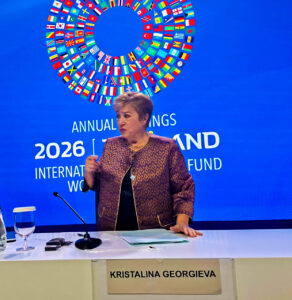
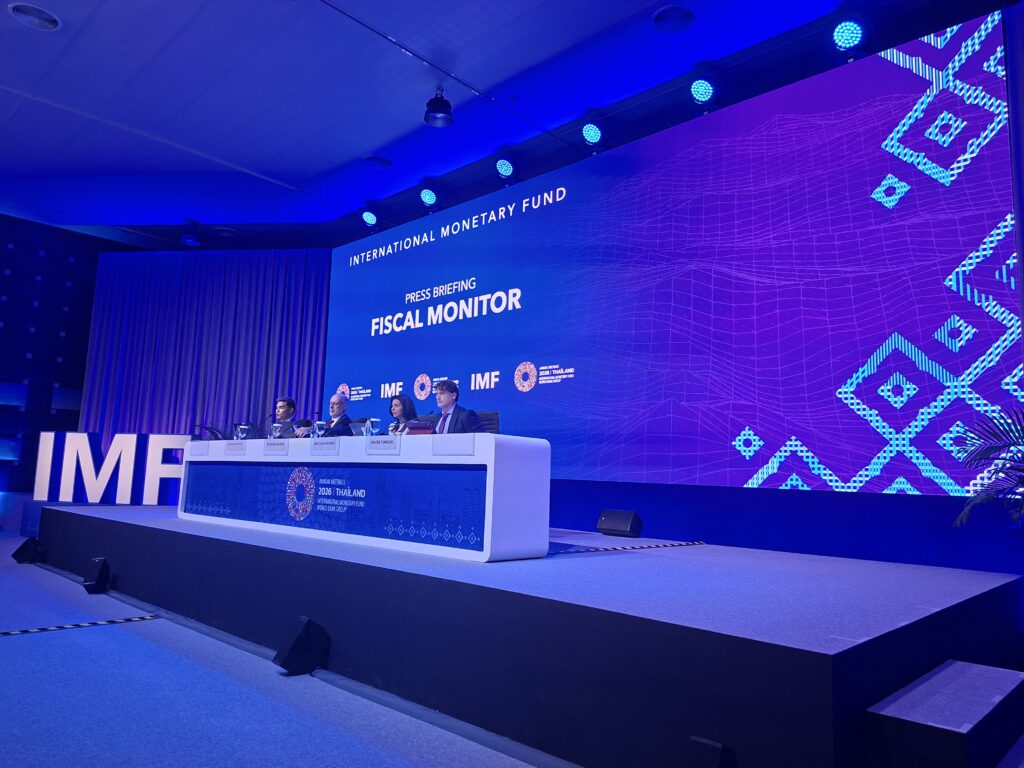
The warning was issued on Wednesday during the presentation of the October 2026 Fiscal Monitor at the ongoing IMF and World Bank Annual Meetings in Bangkok, Thailand.
The Fund said global public debt rose to 94 per cent of GDP in 2025, with the accumulation driven largely by major economies, while rising interest rates and mounting expenditure commitments were making debt stabilisation increasingly difficult.
Presenting the report, Rodrigo Valdés, Director of the IMF’s Fiscal Affairs Department, said the resilience of global economic activity had not translated into a meaningful improvement in fiscal outcomes, warning that the window for orderly fiscal adjustment was narrowing.
Valdés, alongside Era Dabla-Norris, Deputy Director of the department, and Davide Furceri, a Division Chief, said governments needed to act before worsening market conditions forced more painful adjustments.
He explained that although the Fund expected fiscal balances to improve, the projected outcome was not guaranteed, particularly as governments faced competing demands from social spending, defence, healthcare and other development priorities.
The IMF said higher interest rates were gradually increasing debt-servicing costs because governments refinance their obligations over several years. As existing debt is refinanced at higher rates, interest payments are expected to place additional pressure on public budgets.
The Fund highlighted the importance of the interest-growth differential, commonly expressed as r minus g, which measures the difference between the interest rate on public debt and the rate of economic growth.
When interest rates rise above economic growth rates, debt tends to accumulate more rapidly relative to GDP, making it harder for governments to stabilise their debt burdens, particularly when they continue to run primary deficits.
The IMF observed that the differential was becoming less favourable across advanced and emerging market economies, increasing the risk of further debt accumulation.
IMF cautions against broad-based fuel subsidies
On the impact of the 2026 energy shock, the Fund warned that governments were spending heavily on fuel subsidies and other measures designed to prevent domestic prices from reflecting global supply constraints.
Valdés said fully suppressing fuel prices following the shock could cost a typical country between one and 1.5 per cent of GDP, describing such interventions as expensive and often regressive.
The Fund also estimated that the combined fiscal cost of price-suppression measures globally was approximately 0.5 per cent of world GDP.
It said broad-based subsidies often benefited higher-income households disproportionately because they generally consumed more fuel, while limiting the adjustment in demand needed when global supplies were constrained.
The IMF advised countries to replace universal subsidies with temporary and targeted assistance for vulnerable households, including social safety nets, transportation support and other carefully designed interventions.
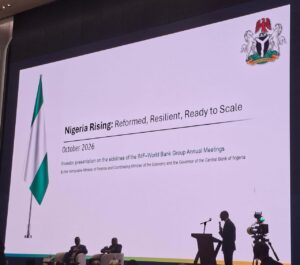
The recommendations featured prominently during questions from Nigerian journalists, who asked how the government could balance rising living costs, inflation, debt-servicing obligations and the need to protect vulnerable citizens following fuel subsidy removal and the introduction of tax reforms.
One journalist noted that Nigeria’s debt-servicing costs were estimated at about 42 per cent of projected government revenue for the year, despite increased revenue following recent reforms.
Responding to questions on fiscal consolidation and energy support, the IMF officials said countries needed to tailor their adjustments to their economic circumstances rather than apply a uniform approach.
They acknowledged that higher fuel prices could increase transportation costs and worsen the hardship faced by households but maintained that broad-based subsidies were an expensive way to address the problem.
The Fund suggested that governments could redirect part of the resources otherwise spent on universal subsidies towards targeted transportation assistance, school feeding, geographical support programmes and vulnerable farmers.
It also encouraged countries to develop household registries and digital payment systems to improve the delivery of assistance over the medium term.
The IMF said such measures would allow governments to protect those most affected by price increases without creating unsustainable fiscal burdens or preventing necessary adjustments in energy consumption.
Fund calls for better taxation, spending efficiency
Beyond subsidy reforms, the IMF urged emerging and developing economies to improve domestic revenue mobilisation by broadening tax bases, removing inefficient exemptions, simplifying tax systems and strengthening tax administration.
Davide Furceri said countries could generate additional revenue by addressing weaknesses in tax policy and improving compliance without necessarily imposing higher tax rates across the board.
He cited research showing that tax administration reforms in some countries had generated additional revenue equivalent to almost two per cent of GDP.
The Fund also warned that complicated tax procedures could discourage investment and hurt the productivity of small and young businesses.
It therefore recommended tax systems that reduced unnecessary economic distortions while improving the efficiency of revenue collection.
For countries with low tax bases, the IMF said stronger domestic revenue mobilisation was necessary to meet debt-servicing obligations and finance essential development programmes.
However, it cautioned that governments must also improve spending efficiency, protect investment in education, healthcare and infrastructure, and direct social assistance towards those most in need.
On Egypt, the Fund said broadening the tax base, reducing exemptions and strengthening tax administration could help raise revenue while supporting economic activity.
In discussing Morocco and other oil-importing economies, the IMF highlighted the importance of reducing costly subsidies, strengthening social transfers and adopting credible medium-term plans to lower debt.
The Fund’s broader message was that countries could support growth by taxing better rather than simply increasing tax burdens, while improving the quality and efficiency of public expenditure.
Ageing populations, defence spending add pressure
The briefing also examined the implications of population ageing and rising defence expenditure for public finances.
Responding to a question about European countries facing pressure to increase military spending, Valdés said governments would have to make difficult choices because defence commitments were likely to persist rather than remain temporary.
He noted that countries could not rely indefinitely on borrowing to finance such spending, particularly where debt levels were already high and the scope for additional revenue mobilisation was limited.
The IMF said governments would need to reassess spending priorities and explain the resulting trade-offs to their citizens.
Dabla-Norris added that persistent expenditure pressures would require careful decisions about which programmes should receive priority and how limited public resources should be allocated.
The Fund also highlighted the fiscal consequences of ageing populations, including rising pension obligations, healthcare costs and demand for care services.
In response to a question about Vietnam, the IMF said pension adequacy and coverage depended partly on bringing more workers into the formal economy.
It stressed that reforms to improve the business environment, sustain economic growth and formalise employment would help expand pension coverage and reduce the risk of old-age poverty.
The Fund said governments needed to prepare for demographic changes early because their effects on public finances could build gradually and become difficult to manage if ignored.
Emerging markets urged to build fiscal buffers
Although emerging markets had remained relatively resilient since late February, the IMF warned that the impact of higher sovereign borrowing costs would vary considerably across countries.
It attributed the resilience partly to stronger policy frameworks, larger domestic investor bases and longer debt maturities.
However, countries with high debt levels, substantial financing needs and limited fiscal space remained more vulnerable to changing financial conditions.
The Fund urged countries that still had access to favourable market financing to strengthen debt management, establish credible fiscal plans and build buffers against future shocks.
It also warned that delaying fiscal consolidation could increase the eventual cost of adjustment as higher interest rates raised debt-servicing obligations and reduced the resources available for essential services.
On the Caribbean, the IMF stressed that countries needed to prepare for both global economic disruptions and climate-related shocks by building fiscal buffers before disasters occurred.
The Fund cited Jamaica’s experience in building financial buffers as an example of the importance of preparing for unexpected shocks.
For Latin American economies, the IMF called for credible fiscal adjustment, improved revenue collection and more efficient spending, noting that countries facing significant fiscal deterioration needed to address both revenue and expenditure pressures.
The IMF maintained that the urgency of fiscal reform had increased because higher borrowing costs had changed the conditions under which governments could sustain elevated debt levels.
It urged policymakers to begin credible, carefully sequenced adjustments now, rather than wait for financial markets to force them into more abrupt and disruptive measures.
Good production costs money and you can support what we do. Please find our details below👇🏾👇🏾👇🏾 Account name: MARKET ONLINE MEDIA Bank: UBA Acc No: 1026401930.