









Barbara Bako, Bangkok.
The International Monetary Fund (IMF) has urged its wealthier member countries to replenish its catastrophe relief fund and honour financing commitments to support low-income economies facing rising debt-servicing costs and mounting economic pressures.
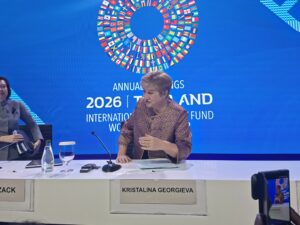
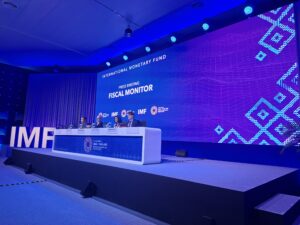
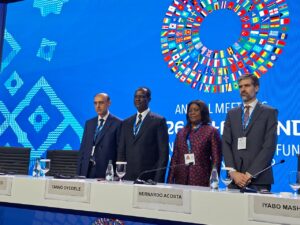
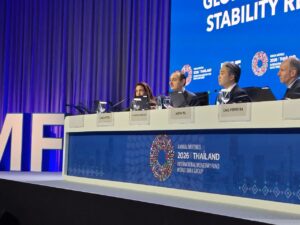
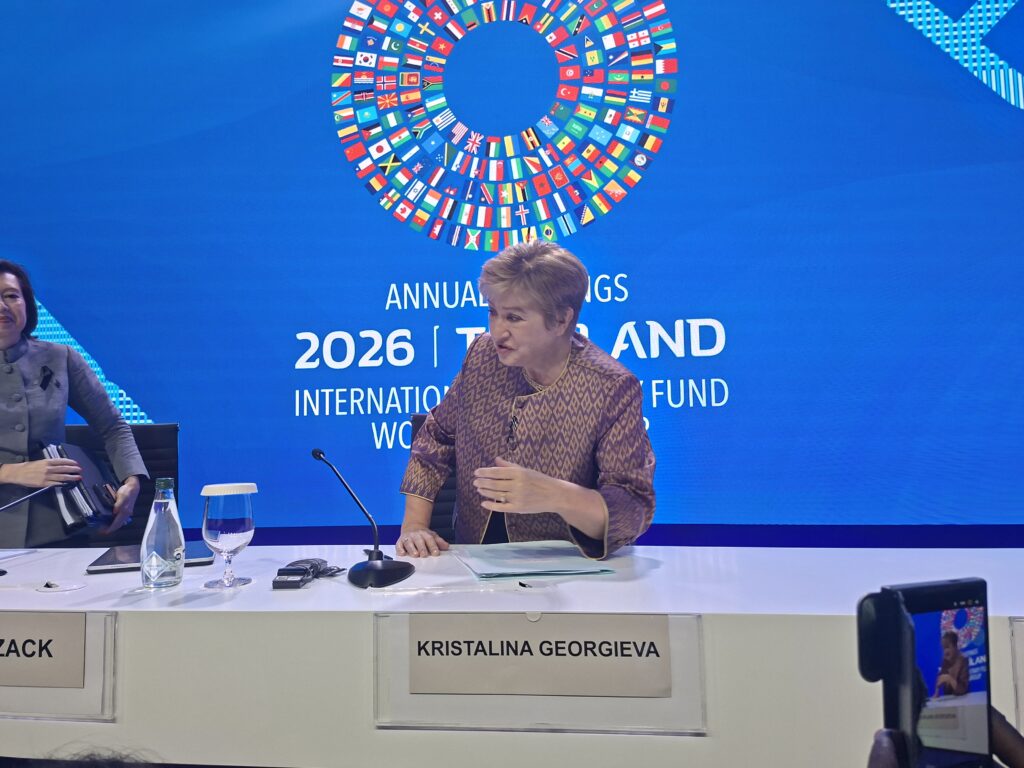
IMF Managing Director Kristalina Georgieva made the call at a press briefing on the Fund’s Global Policy Agenda during the 2026 IMF and World Bank Annual Meetings in Bangkok, Thailand.
Georgieva said debt-servicing costs in low-income countries had risen from six per cent of government revenue a decade ago to 14 per cent currently, despite some improvements in their overall debt levels.
She attributed the increase largely to higher global interest rates, which have made borrowing more expensive and reduced the resources available to governments for development spending.
“Debt levels in low-income countries have gone slightly down. Let me be fair; it doesn’t mean that debt service costs have gone down. On the contrary, because of the lift in interest rates globally, debt service costs have gone up from 6% a decade ago to 14% of their revenues today,” she said.
Georgieva acknowledged that declining development assistance and rising financing costs were putting additional pressure on vulnerable economies, warning that countries risked losing development gains achieved through years of reforms.
She said the IMF had reformed its Poverty Reduction and Growth Trust (PRGT) to enable it to triple lending to low-income countries when necessary.
The Managing Director urged member countries to fulfil their financial commitments to the facility, noting that several low-income countries had already made pledges.
She also called for the replenishment of the Fund’s catastrophe relief trust, which provides assistance to eligible countries facing severe disasters and other qualifying crises.
“We still have a bit of money in it, so we can still act, but we have so often had to rush to use the Catastrophe Containment and Relief Trust that, indeed, we are in need of replenishment,” she said.
Georgieva added that the IMF would continue urging wealthier members to contribute to the facility to ensure that vulnerable countries could access support when crises occurred.
On debt restructuring, she disclosed that Senegal had requested debt treatment and that the IMF was deploying its good offices to facilitate discussions between the country and its creditors.
She said the Fund had reached a staff-level agreement on a programme worth about $2.2 billion to help Senegal address its fiscal difficulties, which were largely linked to previously undisclosed debt.
According to her, the IMF would not participate directly in the debt negotiations but would provide objective analysis of the size and structure of the debt while bringing creditors and the debtor together to build trust and accelerate a resolution.
Georgieva described the Senegal process as an important test of the debt-restructuring framework developed through the Global Sovereign Debt Roundtable and the G20 Common Framework.
She expressed optimism that the process would demonstrate that the improved framework could deliver timely solutions for countries facing unsustainable debt burdens.
The IMF chief also called for urgent fiscal reforms, urging governments to increase revenues, rationalise expenditure and improve public financial management.
As food and energy prices rise, she said governments should protect vulnerable households through temporary and targeted assistance rather than broad measures that distort market price signals.
On the global economic outlook, Georgieva said the Fund expected the world economy to grow by 3.1 per cent in 2026, unchanged from its April projection but below the 3.4 per cent growth recorded in 2025.
She warned that global resilience was being tested by repeated shocks, persistent inflation, higher interest rates and rising public debt.
Low-income countries and fragile and conflict-affected states, particularly energy importers and economies excluded from the artificial intelligence boom, were among those facing the greatest pressures.
Georgieva also warned that borrowing costs could remain higher for longer because of structural changes in global financial conditions, including inflation, increased demand for investment and concerns about fiscal sustainability in advanced economies.
She urged emerging and developing economies to strengthen their macroeconomic foundations, improve growth prospects and deepen regional economic cooperation to withstand external shocks.
On global imbalances, she said the IMF had recorded a further increase in excessive imbalances in 2025, reaching 0.7 per cent of global gross domestic product.
She called on China to increase domestic consumption, the United States to raise savings and reduce its fiscal deficit over time, and European economies to improve competitiveness and investment.
Georgieva further highlighted the opportunities and risks associated with artificial intelligence, warning that disappointing short-term returns on AI investments could trigger disorderly market corrections.
She urged governments to strengthen cybersecurity, address excessive market concentration, improve digital and energy infrastructure and adopt policies that would help workers benefit from technological change.
The IMF Managing Director said the Fund had undertaken policy reforms to improve its ability to identify risks, analyse economic imbalances, support effective country-specific reforms and strengthen its assistance to low-income members.
She reiterated that international cooperation and adequate financial support would be essential to helping vulnerable economies navigate the increasingly uncertain global economic environment.
Good production costs money and you can support what we do. Please find our details below👇🏾👇🏾👇🏾 Account name: MARKET ONLINE MEDIA Bank: UBA Acc No: 1026401930.