










Barbara Bako, Bangkok.
The International Monetary Fund (IMF) has urged Nigeria to provide targeted, temporary cash transfers to vulnerable households to cushion the impact of rising food and energy costs, warning that economic growth alone has not eased the hardship faced by many citizens.
The Fund said the intervention should be accompanied by a credible medium-term fiscal framework focused on improving public expenditure and strengthening revenue collection to protect vulnerable households while ensuring public debt remains sustainable.
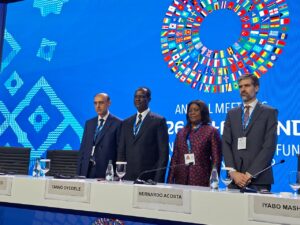
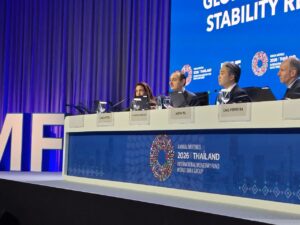
The recommendation was made during the launch of the IMF’s October 2026 World Economic Outlook, titled “Resilience and Restraint: Urgent Choices,” at the ongoing IMF and World Bank Annual Meetings in Bangkok, Thailand.
Responding to a question on how African governments could pursue fiscal consolidation and put public debt on a sustainable downward trajectory without imposing further hardship on citizens, the IMF said policymakers needed to balance immediate household needs with long-term economic stability.
Nigeria was cited as an example of an economy where growth had held up despite persistent pressure on living standards, food insecurity and the high cost of essential goods.
The Fund advocated targeted income support for the most vulnerable households, noting that cash transfers could help reduce poverty and improve food security.
It also recommended improving the quality of public expenditure and strengthening revenue collection within a credible medium-term fiscal framework.
Presenting the report, Sylvana Tenreyro, the IMF’s Economic Counsellor and Director of the Research Department, said global economic growth was projected at 3.1 per cent in 2026, before rising to 3.4 per cent in 2027.
She identified higher energy and commodity prices as major factors weighing on economic activity, while investment in artificial intelligence (AI) and related technologies continued to support growth.
According to the report, these opposing forces are shaping the global economic outlook, with risks tilted to the downside.
Tenreyro also warned that rising borrowing costs and debt-servicing obligations could put additional pressure on government finances, limiting resources available for infrastructure, social services and other critical investments.
The report called on governments to rebuild fiscal buffers, strengthen public finances and direct spending towards productive and essential priorities.
However, it stressed that fiscal consolidation should be carefully designed to minimise unnecessary hardship, protect vulnerable groups and avoid measures that could undermine economic recovery.
On monetary policy, the IMF said central banks should remain focused on price stability and the timely return of inflation to target, while considering differences in inflation levels, labour-market conditions and countries’ exposure to commodity-price shocks.
The Fund also underscored the importance of central bank independence, credible monetary policy frameworks and clear communication in anchoring inflation expectations.
Reacting to the report, Eric LeCompte, Executive Director of Jubilee USA Network, criticised the IMF’s growth projections, arguing that they remained below historical standards.
Jubilee USA Network, a faith-based development organisation that monitors international financial institutions, issued a statement on the IMF meetings, raising concerns about the outlook for the global economy and its implications for developing countries.
“The data from the report is concerning, but the IMF continues to give rosy future growth projections for the economy,” LeCompte said.
He also questioned the expectation that investment in artificial intelligence would sustain economic growth, warning that developing countries could face deeper crises if the technology failed to strengthen economic activity and deliver broader benefits.
“The expectation reported that AI will keep the economy afloat is unrealistic. If AI fails to strengthen the economy and help developing countries, the crises facing most of the world become worse,” he said.
Jubilee USA Network further raised concerns about rising food and fuel prices, saying the pressures were worsening conditions for vulnerable populations.
The organisation called for greater attention to the needs of the poorest people as governments and international financial institutions pursue economic and financial reforms.
Concluding her presentation, Tenreyro said the global economy needed to move beyond coping with shocks towards rebuilding resilience through stronger public finances, improved supply-side capacity and measures to safeguard financial stability.
“The global economy has been resilient, but that resilience is reaching its limits,” she said.
The IMF said strengthening fiscal space and supply-side resilience would help countries withstand future disruptions and support more sustainable economic growth.
Good production costs money and you can support what we do. Please find our details below👇🏾👇🏾👇🏾 Account name: MARKET ONLINE MEDIA Bank: UBA Acc No: 1026401930.