










Barbara Bako, Abuja.
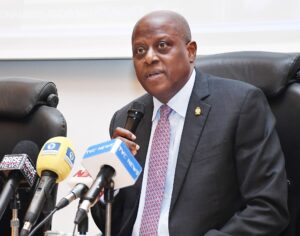
The Authority Chief Executive of the Nigerian Midstream and Downstream Petroleum Regulatory Authority (NMDPRA), Rabiu Abdullahi Umar, has called for urgent investment in infrastructure, logistics and market systems to move West Africa from a petroleum price-taking region to a credible centre of price discovery and trading.
Umar said the region had laid the institutional foundations for a West African refined-products reference market but must now move from developing roadmaps to executing projects capable of supporting transparent pricing, regional trade and investment.
He spoke on Tuesday at the second West Africa Refined Fuel Market Conference in Abuja, themed “Funding West Africa Infrastructure & Distribution to Create a Transparent Market for Regional Price Benchmarks.”
According to Umar, while the inaugural conference in 2025 focused on establishing the foundations for a regional reference market, the priority this year must be to finance and execute the infrastructure and institutional reforms required to make the market functional.
“Last year, our focus was on establishing the foundations. This year, our focus must be on execution,” he said.
He said the 2025 roadmap identified reliable refining capacity, stronger logistics and storage networks, interconnected ports, roads, rail and pipelines, harmonised product and regulatory standards, transparent market data, stronger cross-border cooperation and mobilisation of capital as critical requirements for credible regional price formation.
Umar said progress had been recorded through the establishment of the West Africa Regulators Forum, progress towards West African reference pricing and deeper collaboration with S&P Global Commodity Insights, but stressed that these remained foundations rather than a completed trading hub.
“A reference price is not by itself a trading hub. A conference is not a market,” he said.
He said infrastructure development must cover refineries, pipelines, storage terminals, jetties, ports, rail and road corridors, marine logistics, strategic reserves and digital trading platforms, noting that the objective should be to reduce the cost of moving petroleum products, improve security of supply and create the physical liquidity required for transparent price discovery.
The NMDPRA chief also described Africa’s infrastructure deficit as an investment opportunity, identifying pipelines, storage, marine terminals, refinery expansion and optimisation, road and rail logistics, gas infrastructure, digital commodity exchanges and product-tracking systems among areas requiring investment.
However, he said capital would only flow to projects that were commercially viable and supported by predictable regulation.
“Capital will go where projects are bankable, risks are understood, regulation is predictable and returns can be sustained,” Umar said.
He further stressed the importance of operational efficiency, saying inefficient ports, terminals, pipelines, storage facilities and logistics systems could undermine the competitiveness of the regional market.
On transparency, Umar said credible regional benchmarks could not emerge from an opaque market, as price discovery required sufficient transactions, willing participants, reliable reporting and confidence in market information.
“Markets operate on information. Benchmarks operate on trust,” he said.
He called for deeper regulatory cooperation among West African countries, saying differences in product specifications, licensing processes, tariffs, data definitions and cross-border procedures could increase the cost of regional trade.
Umar identified five priorities for the next phase of the regional market: deepening physical market liquidity, financing strategic infrastructure, accelerating regulatory and product-standard harmonisation, institutionalising market transparency and building a complete trading ecosystem.
He said the emergence of major refining capacity, particularly the Dangote Refinery, was reshaping regional supply chains and creating an opportunity for Africa to exercise greater influence over petroleum pricing.
“In 2025, we developed the roadmap. In 2026, we must finance and execute it,” he said.
The Minister of State for Petroleum Resources, in his remarks, stressed the need to attract greater investment into Nigeria’s midstream and downstream petroleum sectors and strengthen regional cooperation.
He said Nigeria’s refining capacity and strategic position provided an opportunity for the country to serve wider African markets, while urging stakeholders to move away from exporting raw resources and subsequently importing refined products.
The Minister also emphasised the importance of a sustainable pricing mechanism in building an integrated regional petroleum market and expressed the Federal Government’s support for the initiative.
Meanwhile, Vera Blei, Head of Platts, S&P Global Energy, said the development of credible regional benchmarks would require active participation by West African market players rather than reliance on existing international pricing references.
Blei said Platts had introduced intraday regional gasoline price updates, in addition to end-of-day assessments for gasoline, jet fuel and other refined products, while also launching gasoline, diesel and jet-fuel assessments in naira per litre based on regional domestic fundamentals.
She said the company was also developing a data communication window for West Africa to improve market transparency and urged participants to understand the specifications underlying price assessments.
Blei challenged market participants to create the liquidity needed to make regional benchmarks credible, stressing that while Platts could provide the foundation and reference prices, the market itself had to bring them to life.
She also highlighted progress made over the past year, including the establishment of the West Africa Regulators Forum, increased market information and developments in regional refining capacity. S&P Global has also established a functioning Abuja office with a local team.
Chairman of the House Committee on Petroleum Resources (Downstream), Rt. Hon. Ikenga Imo Ugochinyere, pledged legislative support for the development of a credible regional petroleum benchmark.
Ugochinyere said the Committee would work with NMDPRA and the West Africa Regulators Forum to ensure that the price-reporting architecture supporting West African reference prices received clear statutory backing and enforceable compliance obligations.
“A voluntary benchmark is a fragile benchmark,” he said.
He said the expansion of refining capacity, particularly the Dangote Refinery and ongoing rehabilitation of the Port Harcourt, Warri and Kaduna refineries, was changing West Africa’s position from being primarily a destination for refined products to becoming a potential source.
“A region that refines must price. A region that prices must have a benchmark,” he said.
The lawmaker identified liquidity, deliverability, data integrity and trust as the foundations of a credible benchmark, stressing that storage, marine infrastructure, pipelines, road and rail evacuation systems, metering and automation were essential to market transparency.
He also pledged to push for a fiscal and regulatory environment capable of making midstream and downstream infrastructure bankable, while supporting measures to tackle crude oil theft and pipeline vandalism and secure feedstock for domestic refineries.
On regional integration, Ugochinyere said the Committee would engage counterpart legislative committees across West Africa and the ECOWAS Parliament to promote regulatory harmonisation.
He urged participants to leave the conference with bankable projects, implementation timelines and clear responsibility for delivery, stressing that the sector needed to move beyond ideas to execution.
“Ideas are abundant in our sector. Owners are scarce,” he said.
Ugochinyere also announced that the House Committee would hold its second Downstream Week from October 5 to 7, 2026, at the Old Chambers of the National Assembly, focusing on local refining, import dependence, pipeline security and feedstock supply.
Good production costs money and you can support what we do. Please find our details below👇🏾👇🏾👇🏾 Account name: MARKET ONLINE MEDIA Bank: UBA Acc No: 1026401930.