









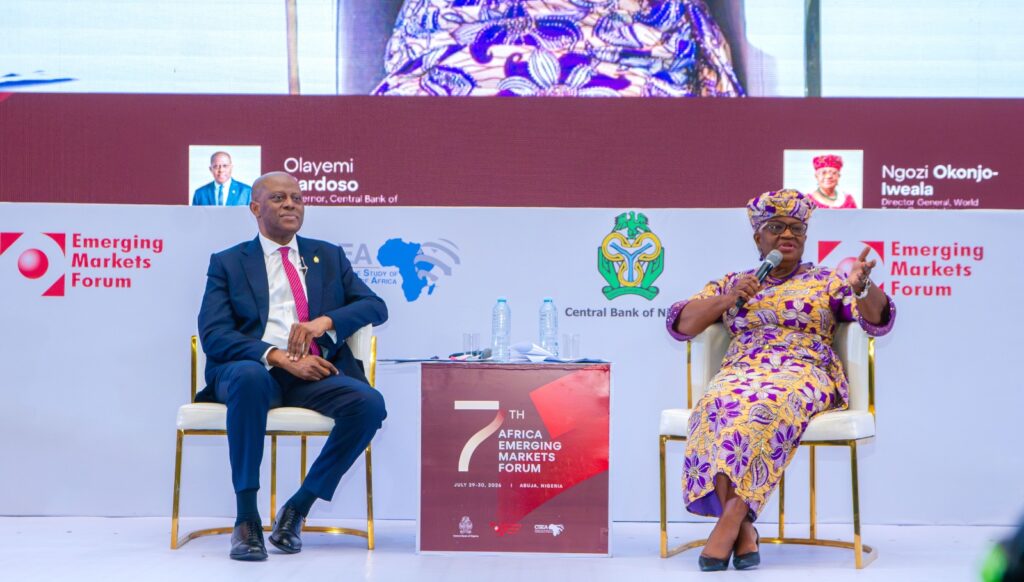
Barbara Bako, Abuja.
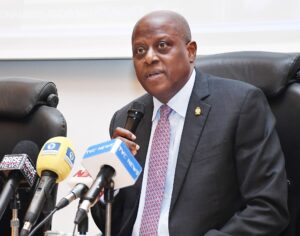
Governor of the Central Bank of Nigeria (CBN), Olayemi Cardoso, and Director-General of the World Trade Organisation (WTO), Dr Ngozi Okonjo-Iweala, on Wednesday urged African countries to strengthen economic reforms, deepen regional integration and invest in technology to position the continent for opportunities emerging from the changing global economic order.
Speaking at the 7th Africa Emerging Markets Forum in Abuja, the two economic leaders said Africa must respond to growing geopolitical tensions, shifting global supply chains and changing investment patterns by building stronger institutions, mobilising domestic resources and creating jobs for its rapidly growing youth population.
Cardoso said the world was undergoing profound economic changes, with trade becoming increasingly fragmented, capital more selective and artificial intelligence reshaping production and global competitiveness.
“The question is no longer whether the global order is changing, but how we turn that change from a source of vulnerability into a source of growth and shared prosperity,” he said.
According to him, Africa must strengthen regional value chains and take full advantage of the African Continental Free Trade Area (AfCFTA), noting that intra-African trade still accounts for only about 16 per cent of the continent’s total trade.
He called for improved transport infrastructure, harmonised customs systems and faster cross-border payment platforms to unlock trade across the continent.
Cardoso also said the era of abundant global liquidity was over, stressing that investors now preferred economies with credible institutions, transparent policies and macroeconomic stability.
“The era of abundant liquidity chasing returns regardless of risk is over,” he said.
“Credibility is not only a central bank concern; it is a national economic asset.”
He urged African countries to mobilise domestic resources including pension funds, insurance assets, diaspora capital and domestic savings to finance development rather than relying excessively on foreign capital.
On technology, the CBN governor said Africa must move beyond consuming innovation to becoming a producer of technology, calling for greater investment in electricity, broadband infrastructure, digital connectivity and artificial intelligence skills.
He said Nigeria’s recent reform including exchange rate unification, tighter monetary policy and greater transparency in the foreign exchange market had restored confidence, strengthened external buffers and improved the resilience of the financial system.
“We have learned one lesson: credibility is built intentionally, one right decision after another, and strengthened through consistent action,” Cardoso said.
Delivering the keynote address, Okonjo-Iweala said reports of the end of globalisation were exaggerated, arguing instead that the world was moving into an era of “competitive interdependence.”
“What we are seeing is not the end of globalisation but its transformation from cooperative to competitive interdependence,” she said.
She said companies across the world were diversifying supply chains to reduce dependence on a few countries, creating significant opportunities for African economies that could provide stable investment environments.
The WTO chief urged African governments to build regional value chains around critical minerals, renewable energy and manufacturing instead of continuing to export raw materials.
She also praised the CBN’s efforts to restore macroeconomic stability but stressed that reforms must ultimately improve the lives of ordinary Nigerians.
“Nigeria needs to continue the work on overall macroeconomic reforms,” she said.
“Above all, Nigeria needs to focus on creating jobs and economic opportunities for a young and hungry population. Nigerians have to feel the dividends of reform in the real economy.”
During a fireside dialogue, both leaders agreed that stronger collaboration between monetary and fiscal authorit
Good production costs money and you can support what we do. Please find our details below👇🏾👇🏾👇🏾 Account name: MARKET ONLINE MEDIA Bank: UBA Acc No: 1026401930.